
Research
Discovery of Pressure Broadening in Emission Lines in Protoplanetary Disks and Direct Constraints on the Hydrogen Gas Distribution
Observationally investigating the distribution of hydrogen gas, which accounts for the majority of the mass of protoplanetary disks, is essential for elucidating the formation processes of planetary systems and the compositions of gas giant planets. Nevertheless, under disk conditions hydrogen gas does not emit observable radiation, making such studies extremely challenging to date. Using archival data from the Atacama Large Millimeter/submillimeter Array, we discovered that carbon monoxide emission lines in the central region of the protoplanetary disk around TW Hya exhibit a characteristic line profile known as pressure broadening, which appears under relatively high pressure conditions. This represents the first detection of pressure broadening in a protoplanetary disk. By exploiting this effect, we successfully placed direct constraints on the gas density distribution in the inner regions of the disk. As a result, we found, among other things, that approximately eight Jupiter masses of gas are present within 5 au from the central star in the TW Hya disk. For a more detailed explanation, please refer to our press release “Model-Independent Method to Weigh Protoplanetary Disks”.
Paper: Yoshida et al., 2022, ApJL, 937, L14
This paper was selected as an AAS Highlight: AAS Nova – Under Pressure: A New Technique for Measuring Gas Surface Density
Furthermore, we have begun applying this method to other objects. Using data from the ALMA Large Program exoALMA, we successfully measured the gas distribution in the disk around the young star RX J.1604.3-2130 A. In this disk, we revealed that dust is concentrated at locations where the gas pressure reaches a maximum.
Paper: Yoshida et al., 2025, ApJL, 984, L19
More details on the exoALMA project: exoALMA Gives Astronomers a New Look at How Planets are Formed: Beyond Planet Hunting, This Survey will Reveal the Mechanics behind Planet Forming Discs
In addition, the edges, or wings, of emission lines produced by pressure broadening directly trace the disk midplane region. By making effective use of this property, it becomes possible to directly estimate the disk midplane temperature, which has been difficult to achieve until now. Once the temperature is estimated, it is also possible to gain insight into the properties of dust. We estimated the midplane temperature of the TW Hya disk and, by comparing it with dust emission, placed constraints on dust sizes and compositions.
Paper: Yoshida et al., 2025, ApJ, 980, 50
Searching for Forming Exoplanets
By observing planets in the process of formation within protoplanetary disks, we can investigate the details of the planet formation process. We have achieved the first detection of silicon sulfide ($\text{SiS}$) isotopologue emission in the disk around MP Muscae. This can be interpreted as originating from the envelope surrounding a planet with a mass much smaller than that of Jupiter. Paper: Yoshida et al., 2026, ApJL, in press
Furthermore, in the following paper, we used sulfur monoxide ($\text{SO}$) molecules to discover an outflow thought to be emanating from an early-stage protoplanet embedded in the disk around TW Hydrae. From the velocity of this outflow, the planetary mass was found to be approximately $4 \, M_{\oplus}$. Additionally, the mass loss rate of the outflow allowed us to estimate the mass accretion rate onto the protoplanet at approximately $3 \times 10^{-4} \, M_{\oplus} \, \text{yr}^{-1}$. These results are consistent with predictions from theoretical studies. Utilizing such outflows may enable us to understand how planets grow. Paper: Yoshida et al., 2024, ApJL, 971, L15 This paper was selected as an AAS Highlight: AAS Nova - A Baby Planet Reveals Its Hiding Place
Discovery of Gravitationally Unstable Planet-Forming Regions Through Time-Domain Astronomy
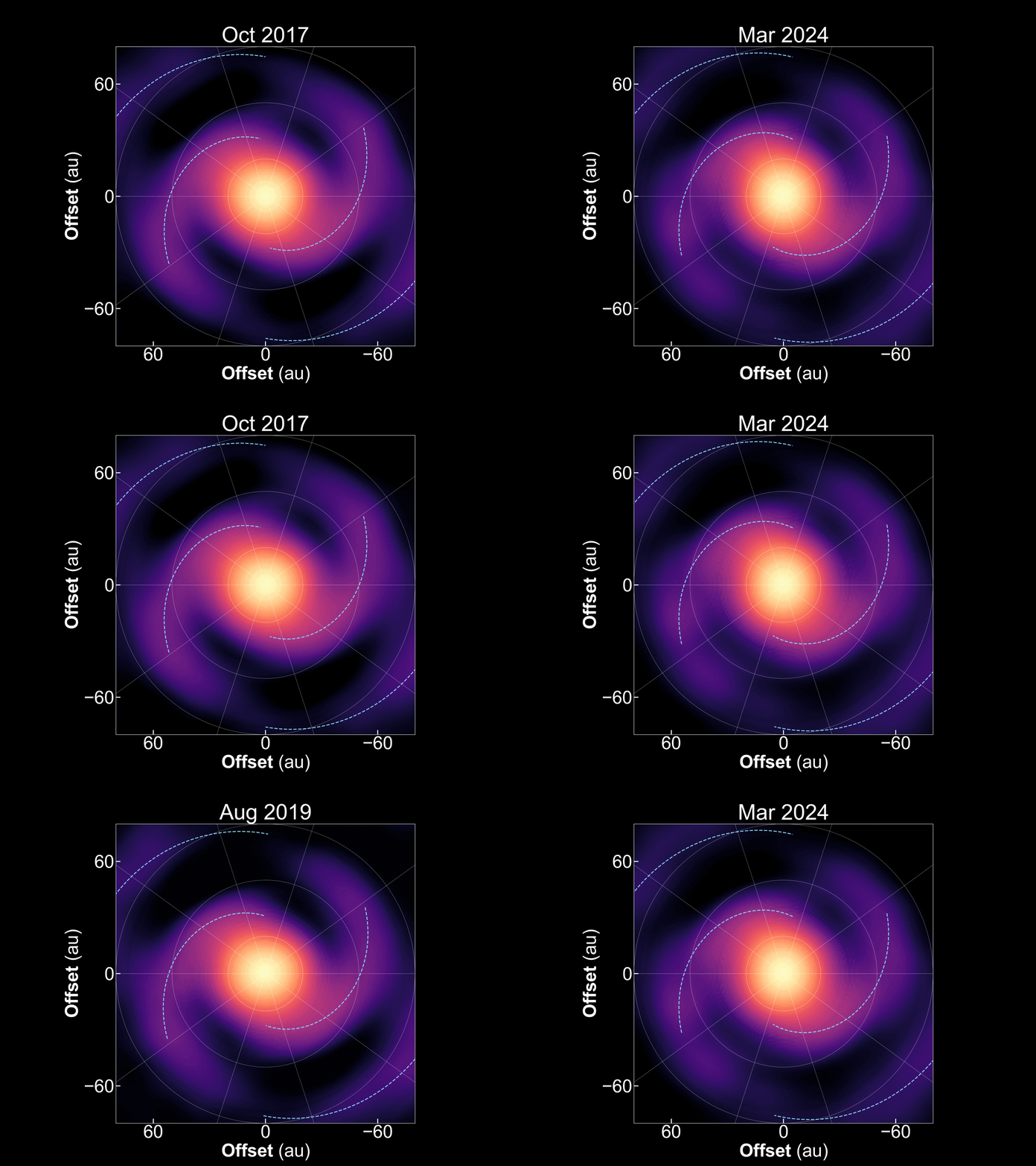
Through seven years of observations with the Atacama Large Millimeter/submillimeter Array, we produced a time-lapse view of the protoplanetary disk around IM Lup in the constellation Lupus and revealed that its inner regions exhibit dynamic motions. This provides the first observational evidence that a planet-forming region is gravitationally unstable. It suggests that gravitational instability is an important mechanism in the process of planetary system formation. For a more detailed explanation, please refer to the ALMA press release – Winding Motion of Planet-Forming Spirals Captured on Video for the First Time.
Paper: Yoshida et al., 2025, Nature Astronomy
Constraints on Molecular Gas Isotopic Ratios in Protoplanetary Disks
Isotopic ratios are an important tool for understanding the evolution and transport of material from protoplanetary disks to planetary systems. However, measuring molecular gas isotopic ratios in protoplanetary disks has been challenging. We developed a new method that uses the wings of molecular emission line spectra and, using archival Atacama Large Millimeter/submillimeter Array data, successfully measured the 12CO to 13CO ratio in the protoplanetary disk around TW Hya. As a result, we found that the 12CO to 13CO ratio is low within a radius of 100 au and higher in the outer regions of the TW Hya disk. This represents the first observation of such a large variation in the carbon isotopic ratio between the inner and outer regions of a single disk. Carbon isotopic ratios are expected to serve as a new tool for probing the origins of planetary system material through future comparisons with other disks and with Solar System materials such as meteorites. For a more detailed explanation, please refer to ALMA News (2022/8/12).
Paper: Yoshida et al., 2022, ApJ, 932, 126
In addition, we discovered that 13CN emission lines are detected in archival Atacama Large Millimeter/submillimeter Array data of the TW Hya disk. By performing non local thermodynamic equilibrium modeling together with observations of 12CN emission lines, we successfully constrained the 12CN to 13CN ratio. The derived value is approximately 70, which is close to the 12C to 13C ratio in the interstellar medium, while differing from the carbon isotopic ratios of carbon monoxide and hydrogen cyanide. This result suggests that complex carbon isotopic fractionation is taking place within protoplanetary disks.
Paper: Yoshida et al., 2024, ApJ, 966, 63
Temporal Variability of Protostellar Jets
Understanding how the masses of Sun-like stars are determined is one of the most important issues in the field of star formation. Protostars formed by the gravitational collapse of molecular clouds grow by accreting surrounding gas, while at the same time launching gas ejections known as protostellar jets and outflows. Because the final stellar mass is affected by the ejected gas, clarifying the mechanisms of gas ejection is crucial. As a first step, it is necessary to determine the physical properties of protostellar jets and outflows. In this study, we measured physical quantities such as the mass loss rate and energy of the protostellar jet and outflow launched from the protostar L1448C(N) using the Submillimeter Array. Observations with the Submillimeter Array were carried out three times over a period of approximately ten years, revealing that features known as knots in the protostellar jet move across the plane of the sky and that new knots are being generated.
Paper: Yoshida et al., 2021, ApJ, 906, 112